The Foreign Alien: Decline, War & Death
In 1910, an event happens that ends Reinhold’s career as a press photographer.
The Daily Express sues Reinhold, purporting that he has committed fraud by fraudulently selling them a photograph of the funeral of William Gladstone, which he had taken in 1898, and passed it off as an image of the preparations for the lying in state of the recently deceased King Edward VII.
“In the City of London court yesterday, an application was made in an action bought by the Daily Express (1908) (Limited) against Messrs. Reinhold, Thiele, and Co., photographers, Chancery-lane. To recover £100 damages for alleged fraudulent misrepresentation in having sold them as genuine for publication in their newspaper what purported to be a photograph of the “preparations for the Lying-in-State at Westminster Hall,” but which the defendant knew did not represent the scene suggested.
Mr. Profumo, the plaintiff’s counsel, stated that instead of the photograph being a representation of the scene of King Edward’s Lying-in-State it was a photograph of the preparations at Westminster Hall for the Lying-in-State of Mr. Gladstone. Mr. W. Cresswell, the defendant’s solicitor, said that they had never asserted that the photograph was a portrait of King Edward’s Lying-in-State.
He asked that an order for the interrogatories which the Registrar had made should be set aside. The plaintiffs had given no particulars as to the alleged misrepresentation nor of the damages.
The defendants were photographers and having in their possession a photograph of Mr. Gladstone’s Lying-in-State they sent the photograph round to the daily papers. The Daily Express published the photograph and added words implying that it was the Lying-in-State of King Edward. They added a lot of the matter. Mr. Profumo observed that the defendants’ present application was both novel and most unusual, and their admission that the photograph did not refer to Kind Edward’s Lying-in-State was astounding.
The defendants’ photograph was stated to represent “preparations for the Lying-in-State at Westminster Hall.” Who on earth would think that those preparations were for the late Mr. Gladstone? The interrogatories ought to be answered.
Judge Lumley Smith, K.C., said that what might be a difficulty was that the parties did not deal directly with each other. The photograph was sent in. He allowed some interrogatories with alterations but not others but gave the plaintiffs the costs in the cause.”
Morning Post – Wednesday 29th June 1910. The British Library Board. All rights reserved.
Whether this was done intentionally or an error made by someone in his studio, the impact was almost immediate. With the story being carried by multiple paper, beyond a few sporting images later appearing in The Sketch, not another photograph by Reinhold’s was ever carried by another Fleet Street publication.
Although no doubt a major blow to his business and was the beginning of a decline in his business; his large and diversified studio at Cheapside would continue trading until 1913, taking him almost to the dawn of the First World War.
The Master Photographer
With his career in photojournalism at an end, there is a distinct change in Reinhold’s style of photography. Whereas his photography had focused on accuracy and true to life representation, with his no longer catering to the Fleet Street press, he starts a new phase of artistic experimentation and would class himself as a “master photographer”.
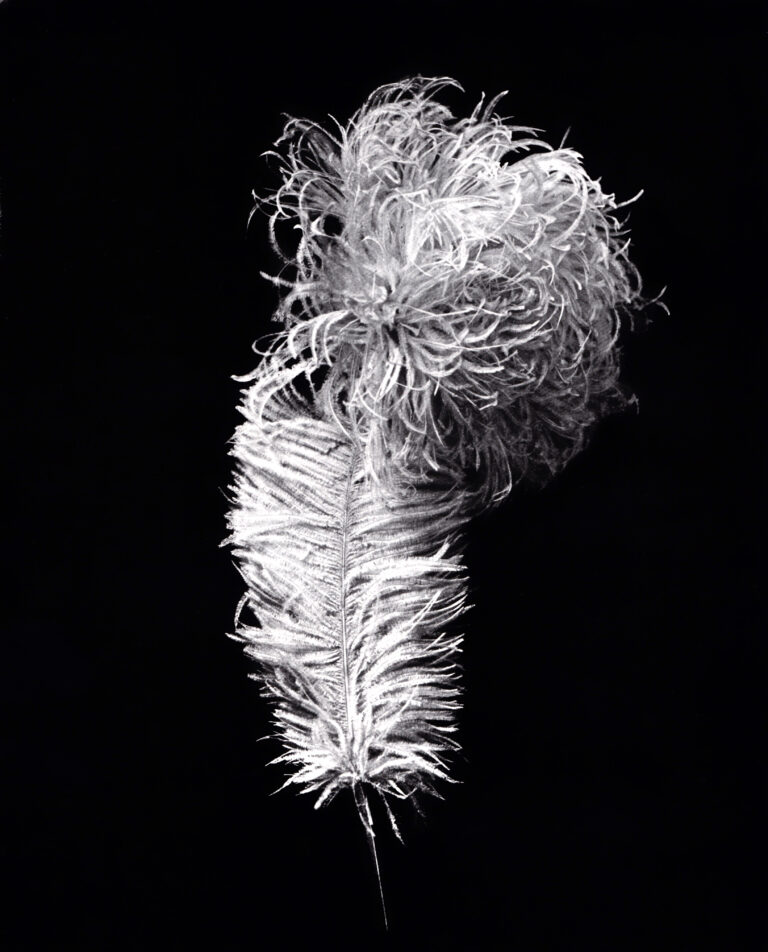
Close-up photograph of an ostrich feather by Reinhold where he experimented with macro-photography in about 1911-12, Reinhold Thiele Family Archive
These photographs feel very distinct to a phase dating 1910-1914, where his portraits take on a softer focus and feel far more expressive than his earlier works.
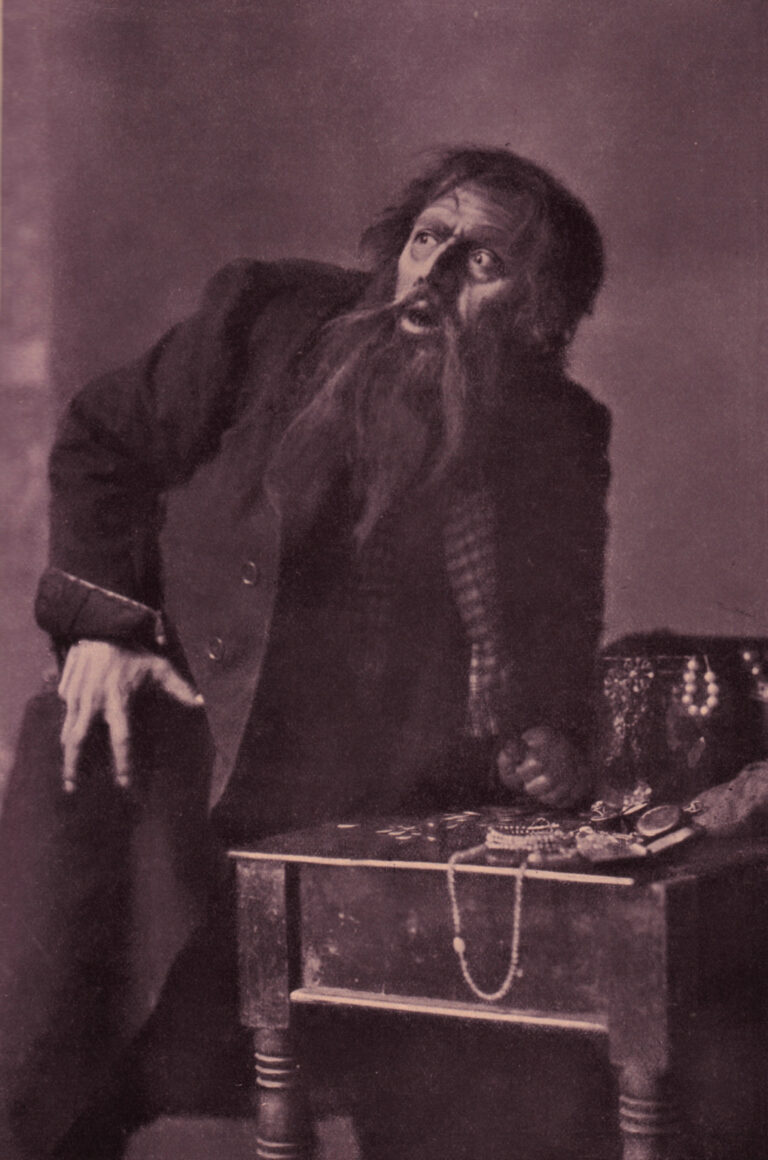
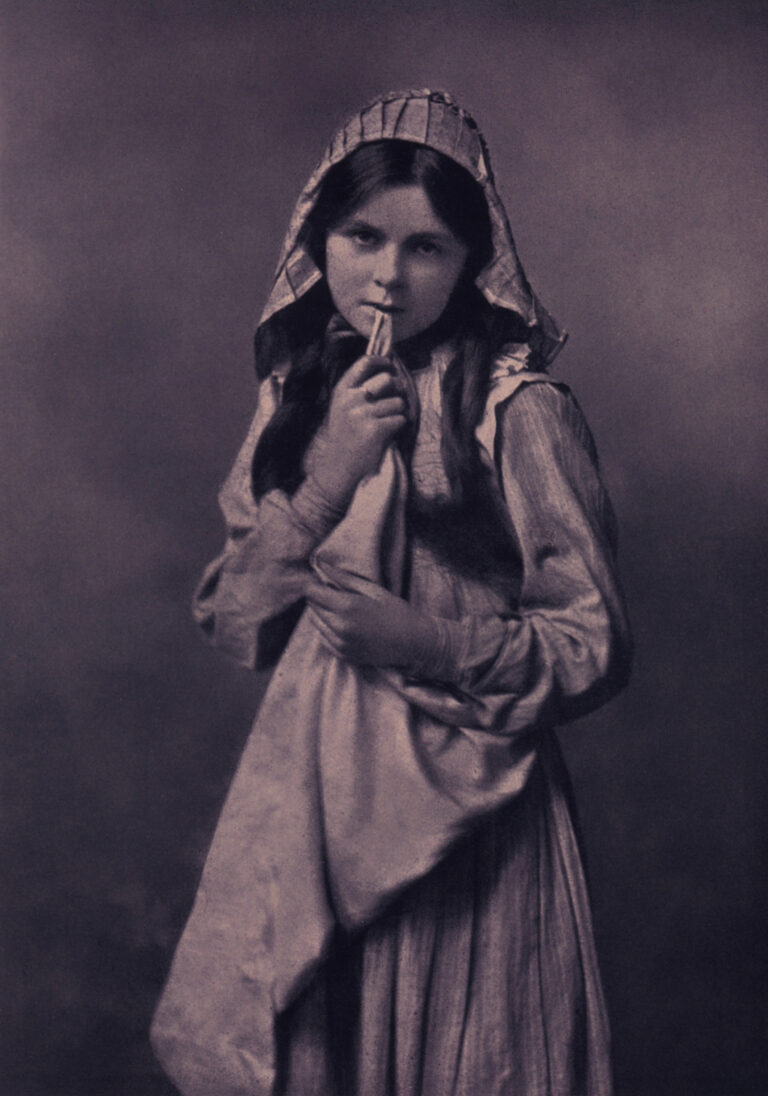
Bransby Williams (1870-1961) as Fagin in Oliver Twist and Miss Ivy Thorpe. Both photographs dating to about 1911-12. Reinhold Thiele Family Archive.
During the early-1910s Reinhold is known to have spent time with the Welsh artist Sir Frank William Brangwyn (1867-1956) and would take several photographs from in his studio. These scenes feel reminiscent of the photographer Ralph Winwood Robinson’s work, capturing artists in their studios.
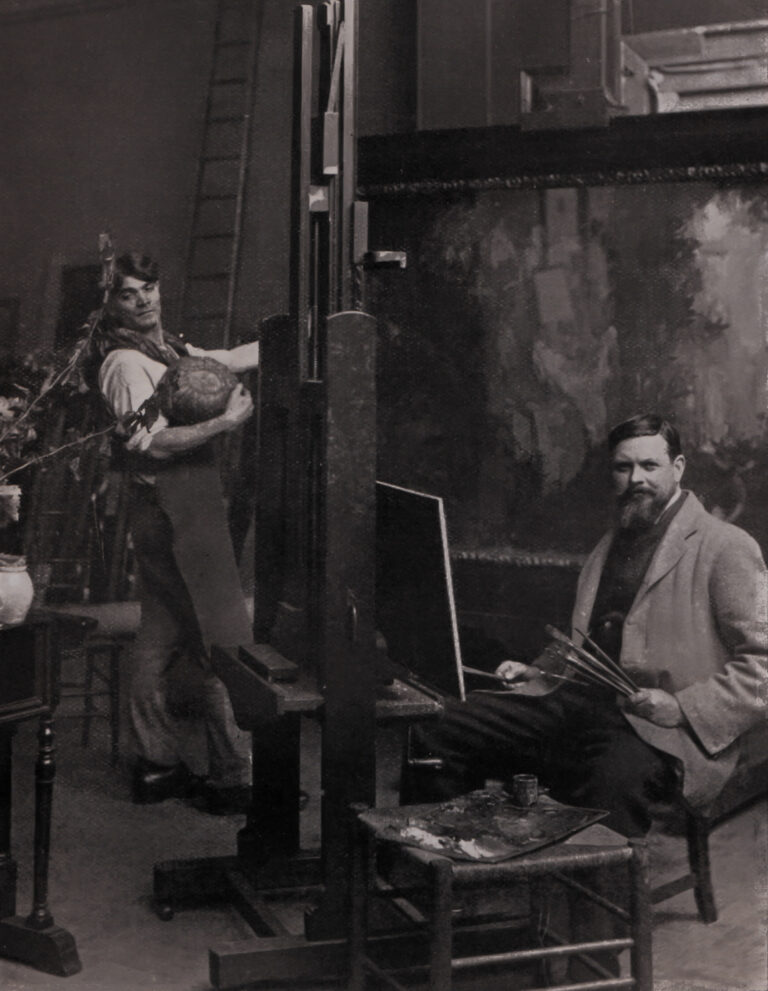
A 1911 print of a photograph by Reinhold of the artist Sir Frank William Brangwyn in his studio. Reinhold Thiele Family Archive.
Reinhold would also continue to travel around the world during this time. A photograph in the Hulton Archive dated to 12th December 1912 places Reinhold in Mexico City during the Mexican Revolution, and less than two months before the coup d’état that became known as the Ten Tragic Days. It is not known what bought Reinhold to Mexico City during this time, if it was to cover the conflict then sadly no other photographs or records are known to survive from this visit.
It would be shortly after this visit that Reinhold would make the decision to let go of his Chancery Studio of almost twenty years and downsize to a smaller one out in Clapton. This was likely down to finances. Cheapside was known as “the greatest thoroughfare in London” and no doubt expensive to keep; and with him no longer doing presswork, he no longer needed a studio in such close proximity to Fleet Street. With the closing of his studio, he would also move the family out to Clapton to be closer to his new workplace.
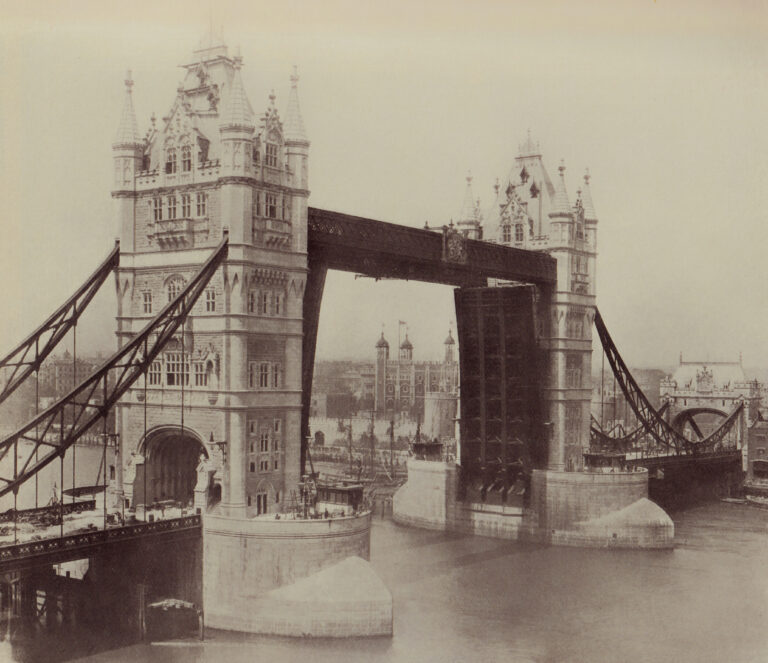
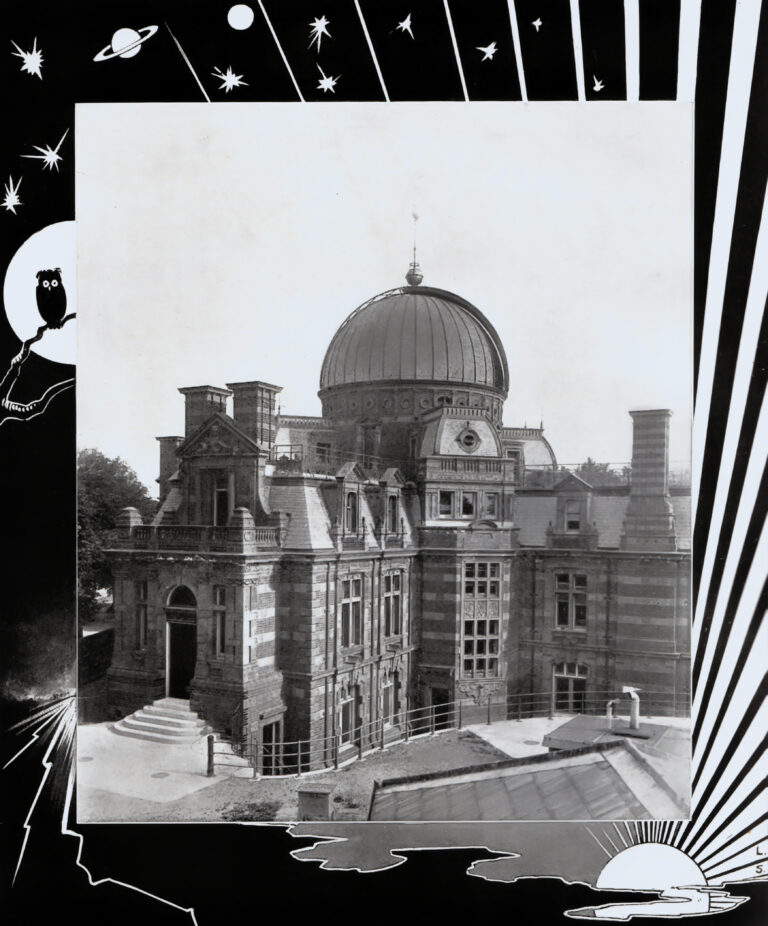
Two late architectural photographs by Reinhold (1911-12). One showing London Bridge, and the other Greenwich Observatory in a rather fun frame. Reinhold Thiele Family Archive.
War, Death & Deportation
The true beginning of the end came in 1914, on 24th May that year, his wife Lily would suddenly pass away aged just 50, they had been married for 30-years. One of the great tragedies of this is that of thirty years of marriage, we know extraordinarily little of Lily’s life, she is almost left as a shadow in the background of her husband’s life.
Combining with the grief of Lily’s death was the outbreak of the First World War just two months later. This meant that their son Carl, who was in the reserves and would become a war poet, was called up as a part of the British Expeditionary Force and fought in the Battle of Mons as part of the 11th Hussars.
News would reach the mourning household that September that Carl was missing in action. It is not known what happened to him at this time, but his unit had been involved in several skirmishes around this time, and one unit was caught behind enemy lines.
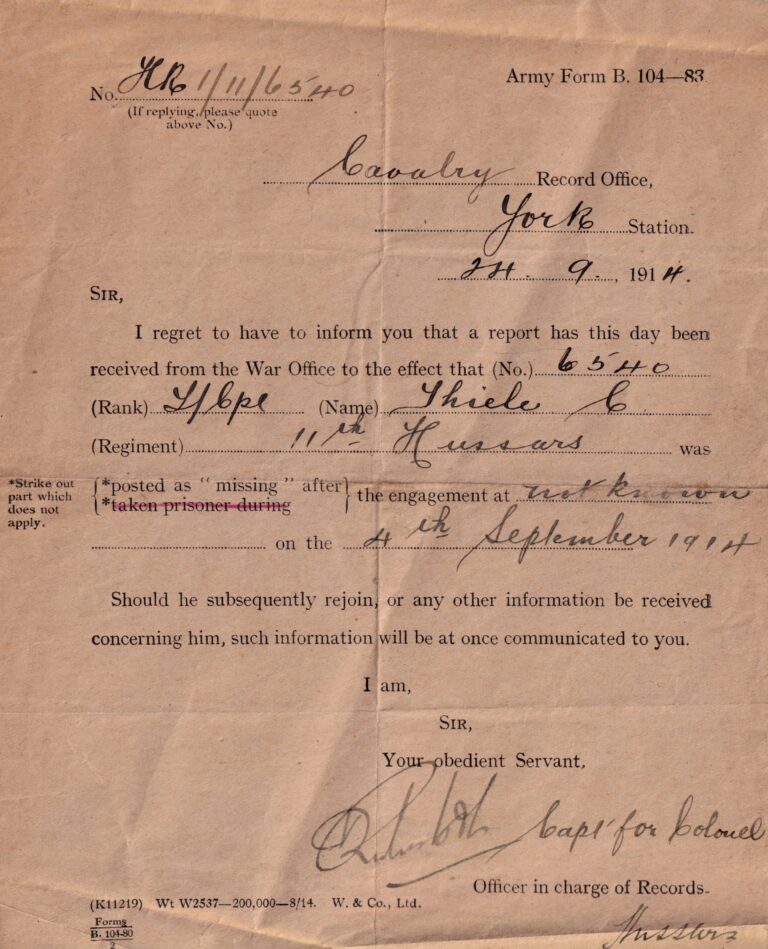
The British Army record that Reinhold received telling him of his son Carl (Charles) Thiele going missing in action during the Great Retreat of the British Expedition Forces. Reinhold Thiele Family Archive.
He would reappear in a hospital in October 1914, but during this fraught time, the eldest son Percy would be invalided out of the Navy and returned home to help Reinhold with the running of his studio.
During his time in the trenches at the front, a twenty-two year old Carl would write and send back war poems to his family. A number of these survive, compiled by his son Peter Georg Batterby Thiele (1923-1999) and cover his time during and after the Second Battle of Ypres.
“Ah! Happy bird, if thou couldst only know
What hidden spring of sorrow sweet was found
Which at thy magic notes again did flow
Through hearts that hard with dry grief long were bound
In one long weary woeful walk with Death.
Ah! Knowing this, thou’dst sob with every breath.
To every mind a vision didst thou bring
Of England’s dear sweet woods and waysides green;
Of coombes and meadows that with laughter ring,
Where time-enchanted is the happy scene
Of wind-swept tree-clad hills lit by the moon,
And treasures ‘neath the hedge in May and June.
Amidst the battle’s roar and iron hail,
In darkness ‘mongst the trees without fear,
A song of praise thou liftedst, mightingale,
Which thro’ the night air rang so true and clear.
Surely there was an angel in thy breast
Who sang to gladden men so sore opprest.”
Composed by Carl on 18th May 1915 during the Second Battle of Ypres whilst holding the town of Hooge, Ypres against shelling and gas. The inspiration – “A nightingale was singing near our trench”.
Adding to this stress, Reinhold would be affected by his status as a German immigrant. He had never considered himself as German. His parents were born into Hanover when it was still a part of the British State, and suddenly finding himself affected by the Aliens Act of 1914 was clearly distressing to him. This can be most clearly seen where in his “Application of Certificate of Naturalisation by Alien resident in the United Kingdom” he refers to himself as “a person about whose nationality a doubt exists.” The civil servant reviewing his case would strike this line from his application and annotate to say he was “an alien”.
His application for citizenship, whilst at times purposefully inaccurate to minimalize his foreign travel, is passionately argued. Stressing his services in the naval reserves, his coverage of the Boer War and his own children’s service to the country.
In a final desperate attempt, he signed off his application by offering to drop his Germanic surname;
“I also desire to be allowed to sign my name in future, Reinhold Teal – since our name and family crest represents a “teal” (wild duck)”
At the time of this application, anti-German sentiments were at a peak, and Reinhold may well have been the victim of active discrimination in his day-to-day life. At this time the assault of suspected Germans and lootings of their businesses was common. The most famous name change at this time is of course of that of King George V, changing the name of the royal household from Saxe-Coburg and Gotha to Windsor.
Although he never went through with taking the surname “Teal”, Reinhold’s children would anglicise theirs in the face of discrimination, with his son Carl Arthur Reinhold Heinrich Thiele, changing his to Charles Arthur Henry Thiele. The scars of the war would affect the family for decades to come, with Reinhold’s granddaughter Ella Mai Rose being cut off from her Germanic routes and barred from learning German, despite her pleas.
Eventually, Reinhold would be granted leave to remain and receive a letter from the Home Office dated 12th October 1915.
“I am directed by the Secretary of State to say that he has under consideration your application for exemption from deportation as an alien enemy, and after consulting the Advisory Committee has decided that you may remain in this country,
This decision has not the effect of releasing you from any of the provisions of the Aliens Restriction Orders applicable to your case and is liable at any time to revocation.” (No: 289023)
Reinhold Thiele Family Archive
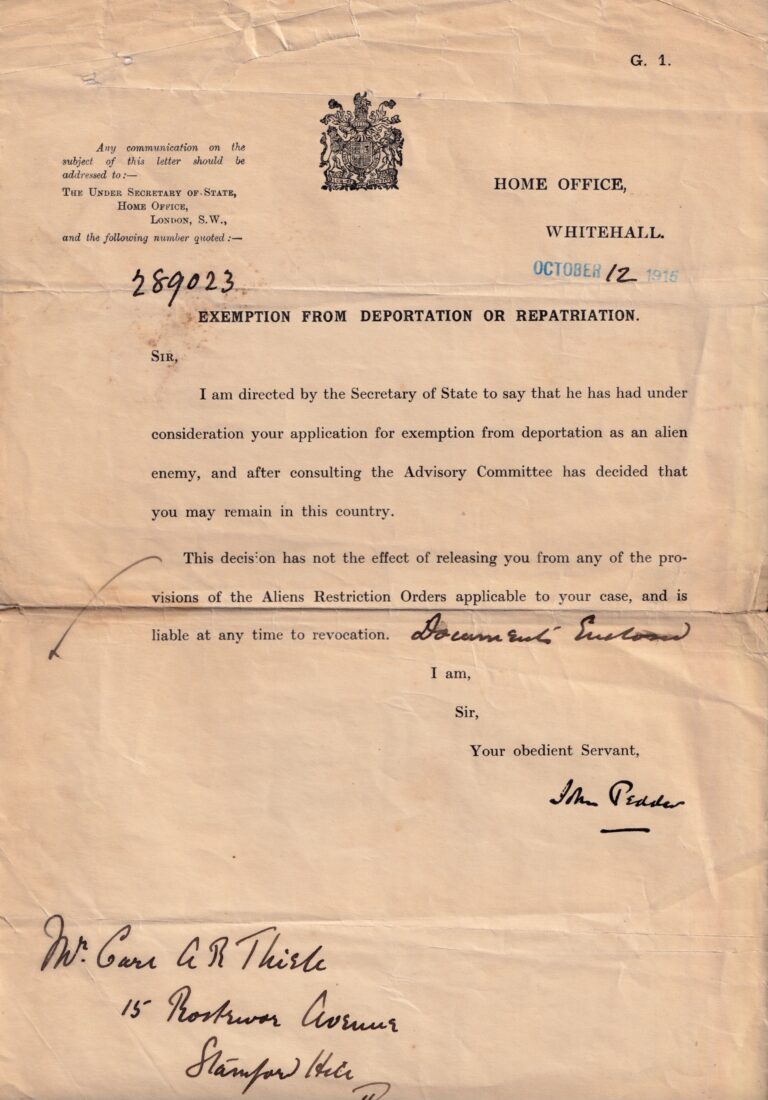
Reinhold’s confirmation on exemption from deportation. Reinhold Thiele Family Archive.
It is likely that Reinhold was then required to register with his local police station and was issued with an Alien Registration Card. He would have also been restricted in his movements and not been allowed to access certain parts of London for the rest of the war.
With this in mind, we know little about Reinhold’s work during the war, not even where his Clapton studio was located. It would be reasonable to assume that the studio was a smaller affair, likely focusing on more classic portraiture, although a 1917 science publication with his works in it shows he was still active in other fields.
What is known is that his daughter Dora Elizabeth Pauline Thiele (1889-1960), who had previously worked in his Chancery Lane Studio, continued to work at his Clapton Studio. Dora appears to have been a major figure in her father’s studio and would later move on to work for the celebrated portraitist, Lallie Charles (1869-1919), who was described as the “foremost female portrait photographer of her day.“
We are aware that from about 1916, Reinhold’s health starts to decline with chest pains and dizziness. No doubt not helped by the stress of losing his wife, decline of his business with the outbreak of the war and the fears of deportation, he was then diagnosed with Aortic Valve Disease.
With declining health and his children moving on, Reinhold surrendered the family house, setting himself up at 66 Park Lane (now called Clissold Crecent), Stoke Newington. Having given up his Clapton Studio, he would initially live and work there, before later fully converting the house into a studio and taking lodgings at 107 Highbury Quadrant, just a ten-minute walk away. He would remain active, trading as a “master photographer” all the way up until his sudden death on 21st April 1921, aged 64.
On his passing, his eldest son Percy would take care of the funeral, having him buried at Willesden Cemetery on 27th April 1921.
In one of the last acts of that day, family papers captured Percy jotting down the costs of the funeral on a piece of his father’s old letterhead paper. A batch of letterhead printed almost a decade earlier and still recalling his father as the “Reinhold Thiele: Press Photographer” of old and encouraging you to visit him at his long-since lost studio on 66 Chancery Lane.