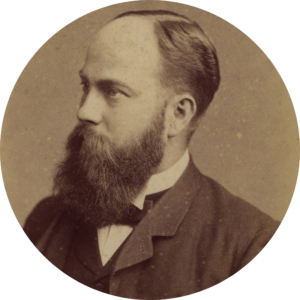
Early Life & Apprenticeship
Karl August Reinhold Thiele was born on 29th January 1856, in Hameln, Kingdom of Hanover to parents Heinrich Georg Thiele and Dorothea Henriette Amalia von Wachsmuth.
He came from an educated, upper-middle class family, perhaps best described as members of the ‘bildungsbürgertum’ class. His father, Heinrich, was a political activist and wealthy merchant, a purveyor of “fancy goods”, in the milliner trade. His mother, Dorothea, came from an old and distinguished Hanoverian family with strong links to hereditary forestry work and the military. Within living memory, her family had held noble titles, with the estates and lordship of Brocklosenborstel and Mackelfeld, near Hamburg.
Reinhold’s passion for art began as a child and was encouraged by his family who enrolled him in the local gymnasium, where he learnt to read and write in Latin and became fluent in German, French, and English. A family friend, the heraldist Friedrich Warnecke (1837-1894), later commented that he believed Reinhold inherited his passion for art from his maternal grandfather, Karl Wilhelm Emil Wauchsmuth (1795-1845), a Lutheran pastor with a keen interest in art and author of several books.
Warnecke goes on to describe how even whilst a student, Reinhold’s talent for art drew the attention of prestigious local families who would commission him. This including the von Münchhausen family, perhaps best known for their famous ancestor, Hieronymus von Münchhausen, whose antics inspired the fictional character of Baron Munchausen.
This patronage is made perhaps more interesting by the fact that Reinhold’s great-great grandmother, Anna Marie Louise von Braun, had famously shot and killed a relative of the Münchhausen family at a party. This scandal would have been etched in memory, especially as the deceased, Count Frederich von der Schulenburg (1711-1765), was famously the grandnephew of the Duchess of Kendal, King George I of Great Britain’s famous mistress.
The world that Reinhold was born into was one on the cusp of change. The Kingdom of Hanover was a relatively new entity, having been born out of the earlier Electorate of Brunswick-Lüneburg, coming into being in the aftermath of the Congress of Vienna in 1814, and only ending its personal union with the United Kingdom in 1837. The political landscape was complex, with Prussia on the ascent and the German Confederation, to which Hanover belonged, growing weaker and more ineffective.
This all came to ahead in 1866 with the Austro-Prussian War between Prussia and the Austrian Empire. Hanover backed Austria, defeating a Prussian army at Battle of Langensalza, but with further Prussian forces advancing through Hanover, its ruler, King George V, surrendered. Hanover was annexed and occupied by Prussian forces just three months later, on 20th September 1866.
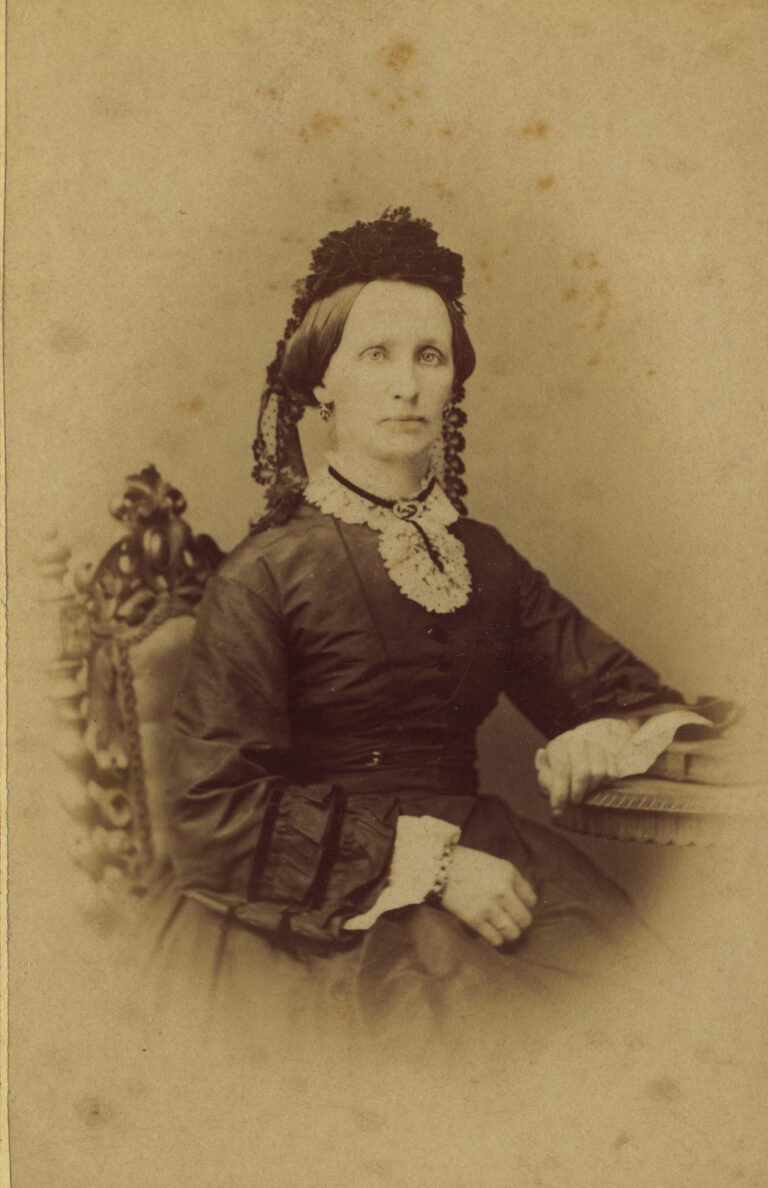
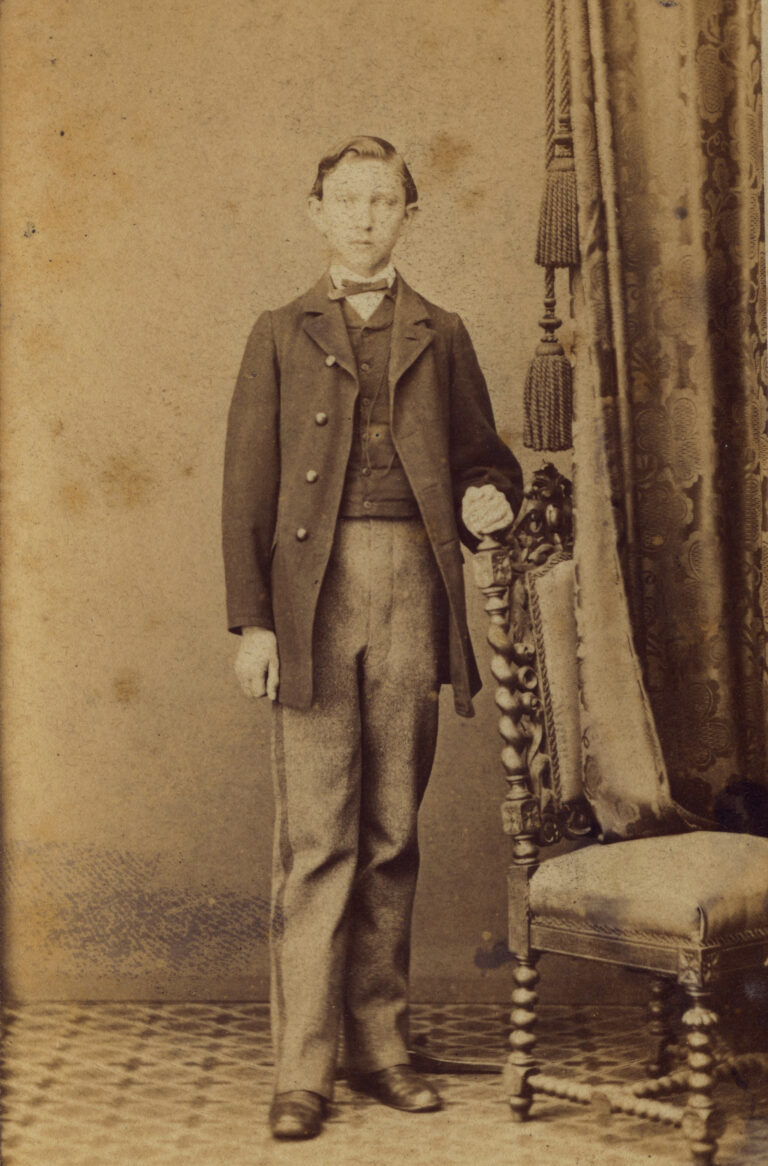
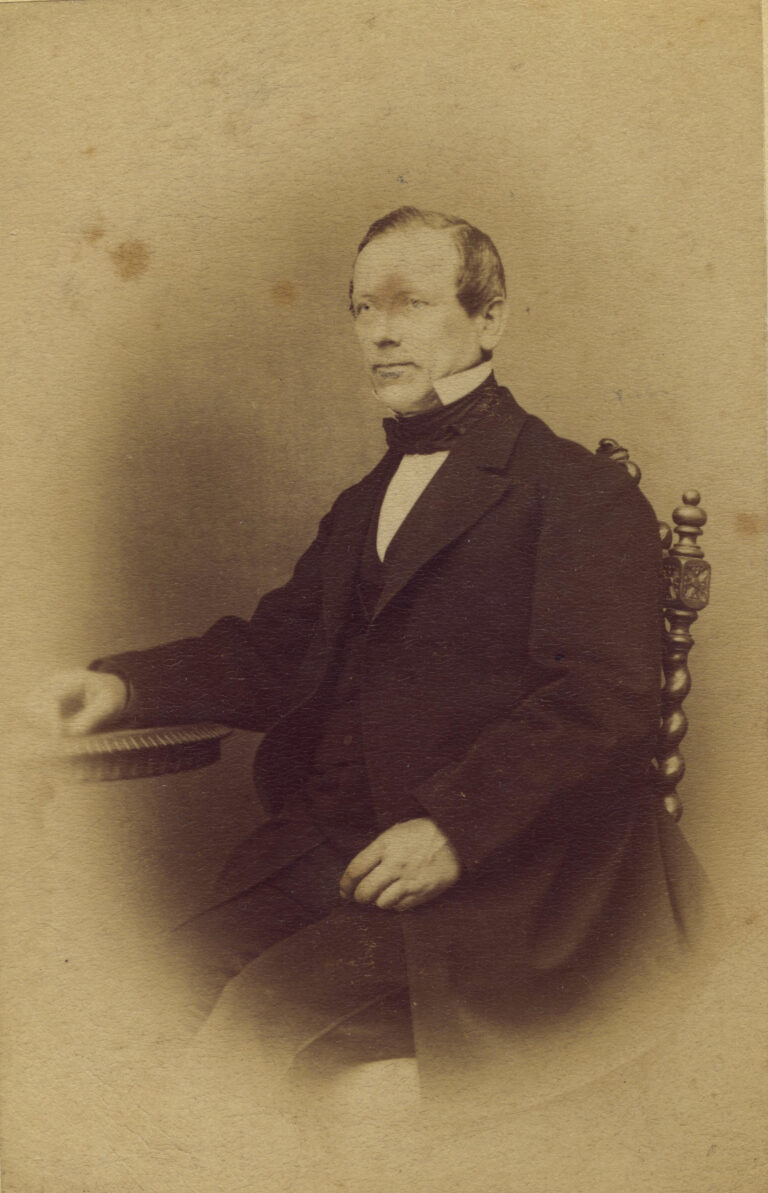
Reinhold Thiele and his parents in the mid-1860s, taken in Herm. Schmidt’s Hameln Studio. His mother, Dorothea Henriette Amalia von Wachsmuth (1834-1907) on the left, Reinhold in the centre, and his father, Heinrich Georg Thiele (1824-1893) on the right. Reinhold Thiele Family Archive
Whilst Reinhold was aged just ten-years at the annexation of Hanover, it was a major turning point for him and his family. Reinhold grew up in a household with a deep distrust of the occupying Prussians and anger over the annexation of Hanover. His mother’s grandfather, Major-general Rudolph Albrecht von Bodecker (1759-1831), had spent thirteen-years traveling and fighting across Europe for the freedom of Hanover during the Napoleonic occupation of the German states, and now Hanover had yet again lost its independence.
Papers belonging to the Thiele family describe how Reinhold’s father Heinrich, an otherwise artistic and musical man, became involved in political activism and in opposing the annexation of Hanover.
The papers follow how Heinrich, as a wealth and influential Hanoverian, was reputedly a founding member of the German-Hanoverian Party (DHP), better known as the Guelph Party. This was a centre-left party and formed in 1867 with the sole intention of restoring the Kingdom of Hanover. Although never successful in its cause, it remained a significant party into the 1920s, when a failed coup and referendum led to its decline, later disbanding in 1933.
It was in these early years of the party that Heinrich was active, and by maintaining friendly relations with local police officers he would be tipped off ahead of impending raids on the family house at Osterstraße. 40 Hameln, giving him time to burn evidence and avoid arrest by the state.
Apprenticeship to the “Nestor of German Photographers”
It was into this world of occupying troops and police raids that Reinhold was sent away from the family home to the City of Hanover, on an apprenticeship that would change the course of his life and set him on the course to be the future father of modern photojournalism.
Reinhold was apprenticed out to Friedrich Karl Wunder (1815-1893), a lithographer and famous early photographer, who was in his own lifetime considered the “Nestor of German Photographers”.
Wunder came from a respected family of scientists and artists, his paternal grandfather, Friedrich Wilhelm Wunder (1742–1828), was an artist and natural scientist, whose print work is still highly collectable. He was apprenticed to the lithographer Georg Heinrich Friedrich Baumgarte (1807-1839) in the early 1830s and would take over management of the business at Baumgarte’s death in 1839. He would later take over the ownership of said business in 1842 when he married Baumgarte’s daughter, Sophie Luise Margarete.
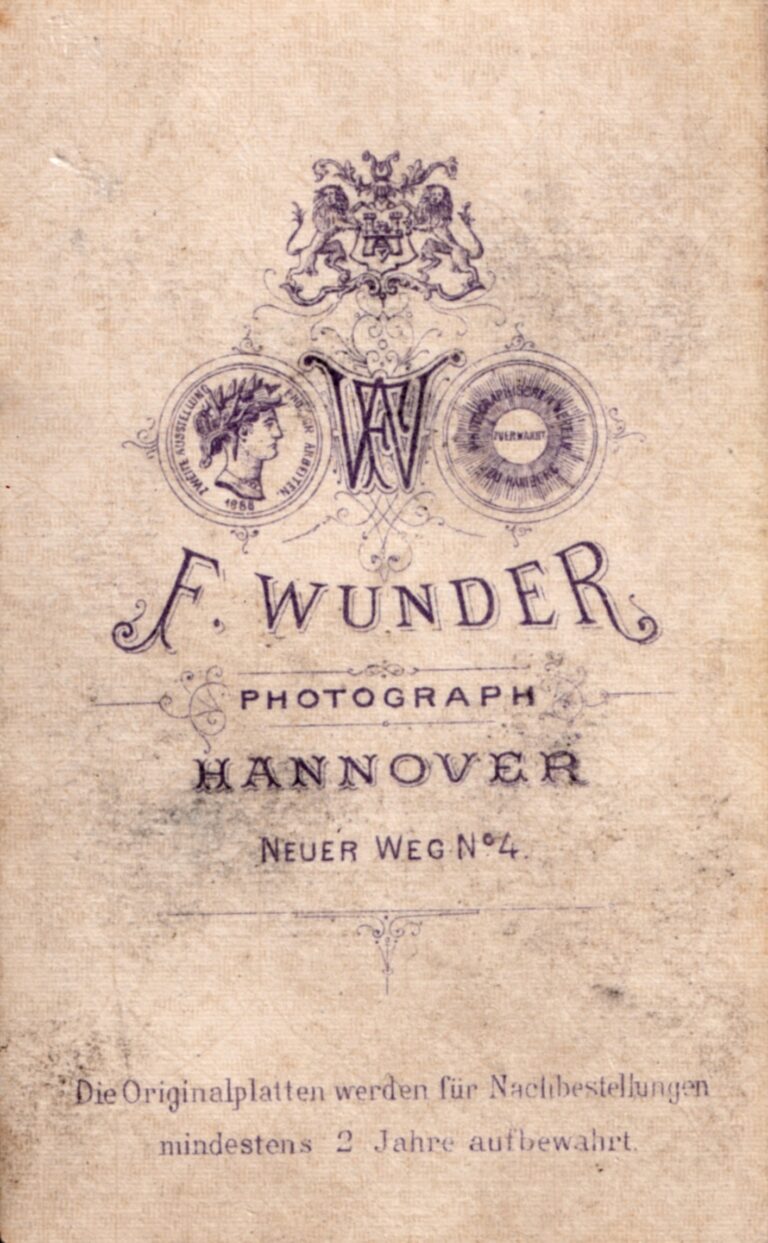
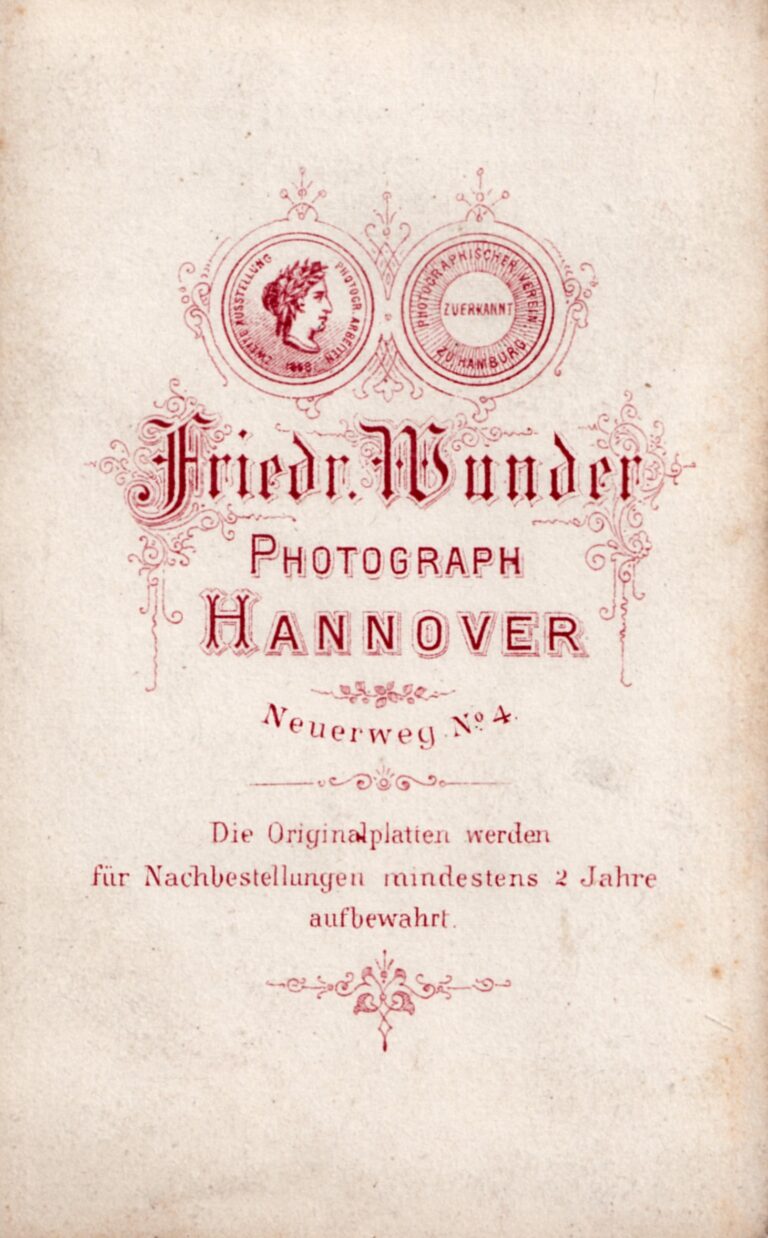
Examples of carte de visite advertisements issued by Wunder’s studio during the time Reinhold was active there. Both show the 1868 Photographic Exhibition medal in pride of place. Reinhold Thiele Family Archive
Although photography had been around in various forms since the 1820s, it was not until the public announcement of the Daguerreotype in France in late-1839 that it entered into the public consciousness. The process was slow; it involved treating a sheet of silver-plated copper to fumes that made it light sensitive, exposing it, before making the image visible using vapour from heated mercury.
It was also highly dangerous, as fellow contemporaries of Wunder discovered, with German photographer Carl Ferdinand Stelzner (1805-1894) going blind from mercury and iodine exposure, and Carl Heinrich Oscar Fielitz (1824-1859) dying from it.
Wunder’s first experiments into daguerreotype in 1841 coincide with developments around exposure times. Until then, photography was better suited for still-lives than portraiture, due to the long exposure times needed. It was with the invention of cameras, such as the Voigtländer Metal Daguerreotype Camera in 1840/41 that it became possible to speed up the process and open the field to the commercial portraiture.
Investing the funds from his lithography and printing business, Wunder would open his first photography studio in 1844, and rapidly scale it up from there. However, it was not until the invention and patent of the carte de visite in 1854 by French photographer André-Adolphe-Eugène Disdéri (1819-1889) that his business really took off. Disdéri had patented a system of printing up to ten images from a single sheet/shot, something that had not been possible until then, and it enabled him to mass-produce photographs. Wunder is known to have quickly adopted the carte de visite, and his success is clearly visible in that by 1856 he was able to expand his studio to a new address at No 4. Neuer Weg, and in 1859, he was able to sell of his printing business and would fully focus on photography.
Reinhold was apprenticed to Wunder in about 1867 or 1869, and by this time Wunder was a well-established and celebrated society photographer with clients that included Karl Marx. At this time Wunder would have long since abandoned daguerreotype photography, sparing Reinhold the dangers of mercury poisoning.
What Reinhold would have been initially apprenticed into was the “wet plate” collodion process. First revealed in 1851, it was both faster and significantly safer than the daguerreotype, and by the end of the 1860s, most studios had almost entirely made the switch. The process still required skill and was time sensitive, with photographers having as little as ten-minutes to go from soaking a glass plate in collodion solution, to photographing their subject, to developing the image. There was also still risk, such as silver nitrate burns and “flash powder” explosions.
Not much is known about Reinhold’s time apprenticed at Wunder’s studio, however, it is likely one of his earliest tasks was the simpler and less dangerous element of using the studio’s existing glass plate negatives to mass-produce the carte de visites that Wunder was famous for. This would have involved developing the albumen paper before hand mounting it on studio branded cards.
Over the next several years he would have been taken through all the different elements of running a large photography studio of the 1860s and 70s, from the development of carte de visite and selling them to the public, through to taking bookings and doing the front-facing studio photography with clients.
During Reinhold’s time at Wunder’s studio, the business was at its peak. Exhibiting his work across Germany, winning medals at Hamburg’s 1868 Photographic Exhibition, an honour that he would actively advertise.
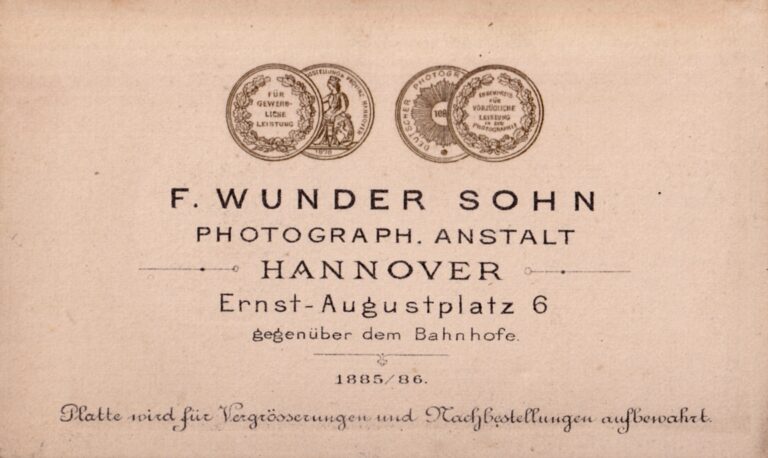
Carte de visite from after when Wunder’s son, Karl Friedrich Wunder (1849-1924), had taken over his father’s studio. The studio would remain open up until at least the 1910s. Reinhold Thiele Family Archive
In 1875, two years after Reinhold left, the second son, Karl Friedrich Wunder (1849-1924), took over his father’s business, which was at this time so prosperous that he was able to commission the construction of a new premises, the celebrated “Wunder-Haus” in the centre of the city of Hanover. The new premises would replace the old studio that Reinhold apprenticed in, at No 4. Neuer Weg, which was located opposite the old School of Arts and Crafts and across from the city’s grand townhall. This original studio would tragically be destroyed in 1943 during bombing raids of the Second World War.
Under Karl’s leadership the Wunder studio would continue into the late 1910s or early 1920s, however, as with his younger brother Otto’s studio, neither would survive the hyperinflation of the Weimar Republic years. Where as the German Mark conversion rate was 90 marks to the US dollar in 1921, by November 1923 the US dollar was worth 4,210,500,000,000 marks.
Otto would pass away in 1921, with Karl following him in 1924, having tragically seen the family fortune wiped out and the Wunder Studio close it’s doors forever.