The Golden Years: Exploration, Invention & Consolidation
On returning from the war, Reinhold’s reputation was stronger than ever. His London studio had remained open during his 8-months away, and on returning he focused on his family and also on curating his war photos, which he would eventually show at the Royal Photographic Society’s annual exhibition of 1901.
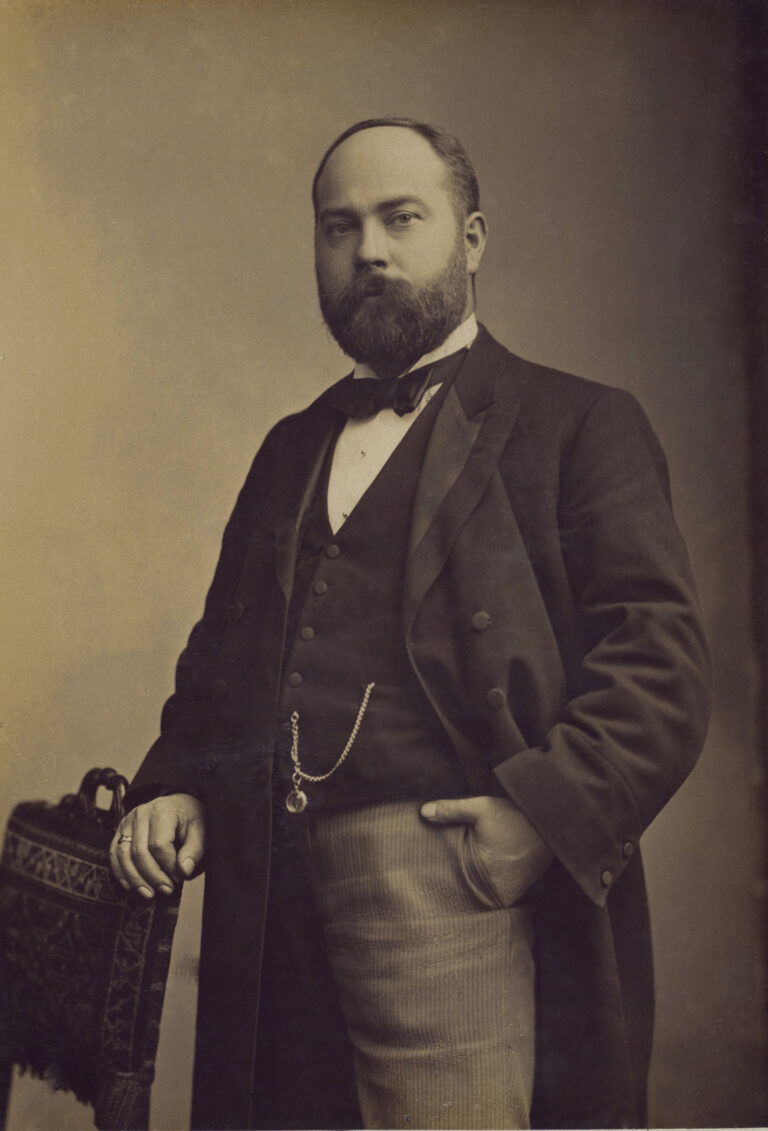
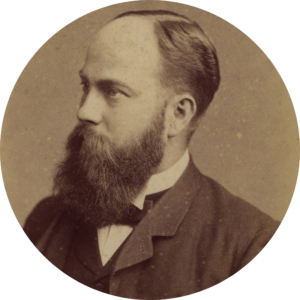
Self-portrait of Reinhold dating to about 1900, on his return from The Boer War. Reinhold Thiele Family Archive
More importantly for Reinhold, he would be spending time with his family. Whilst he was abroad covering the war, his mother Dorothea would travel over from Germany to help take care of Lily and the household. Their second son Charles, who was seven at the time, later remarked that his grandmother had made herself thoroughly disliked by all the children. She would visit again a final time in 1901 for the birth of Lily and Reinhold’s final child, Daniel Hugh Thiele (1901-1971).
His next two major pieces of photojournalism was his coverage of Queen Victoria’s funeral on the 2nd February 1902, and then the coronation of King Edward VII on the 9th August 1902. His photographs appearing across British newspapers and many of his original plates are now in the possession of the Getty.
Returning to his inclusion in the Royal Photographic Society’s annual exhibition of 1901, this exhibition would lead to some of his most beautiful and most collected works.
What the exhibition catalogue refers to as “Variety of Fish caught on Cornish Coast” would appear in the 23rd November 1901 edition of Country Life as a beautiful selection of fish photography, covering everything from Angler Fish to Blue Sharks.
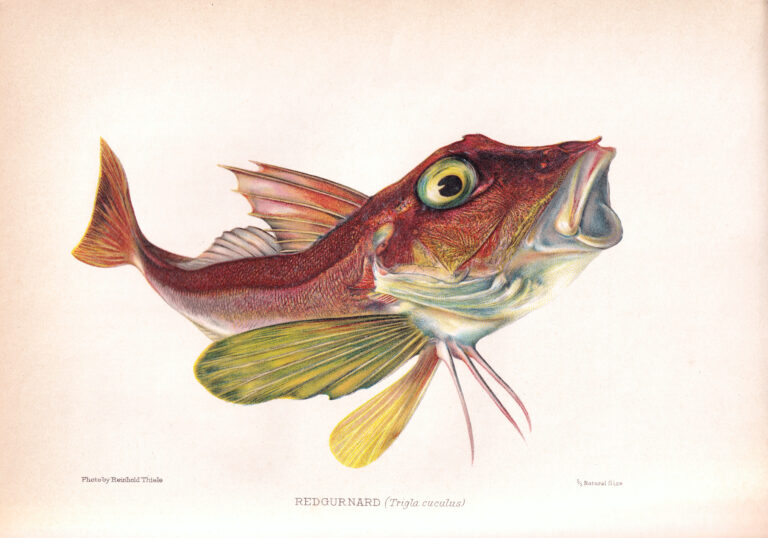
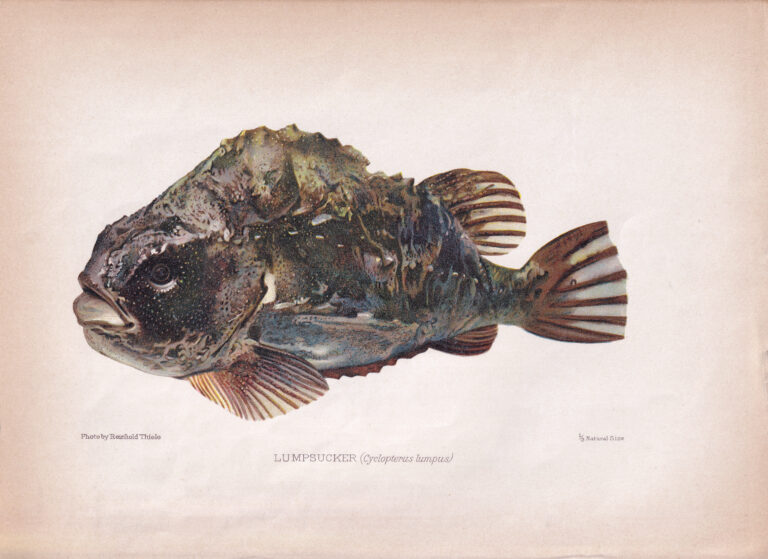
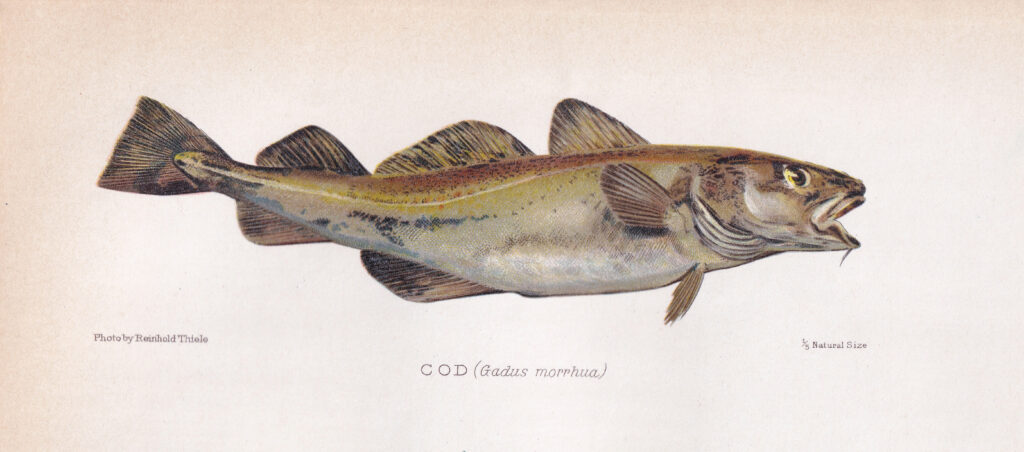
A selection of colour lithographs by Reinhold for the publication “British Salt-Water Fishes (1904). Reinhold Thiele Family Archive
This work would catch the attention of naturalist Frederick G. Aflalo (1870-1918) and angling enthusiast Robert Bright Marston (1853-1927) who would commission Reinhold to illustrate their 1904 book, British Salt-Water Fishes. The book is beautifully illustrated using colour lithographs, perhaps a little too beautifully, as many copies of this book have been destroyed, their illustrations removed and sold off individually as vintage prints.
During the first decade of the 20th Century, Reinhold seems to have continued to expand his business to corner every part of the market; from commercial shots and legal documents to advertising and oil paintings.
From his own advertising he boasted “High Class Portraiture in All Weathers, Rain or Shine” and would advertise in newspapers of making miniature portraits to fit in gold lockets that he stocked. A fitting romantic gift for any lover.
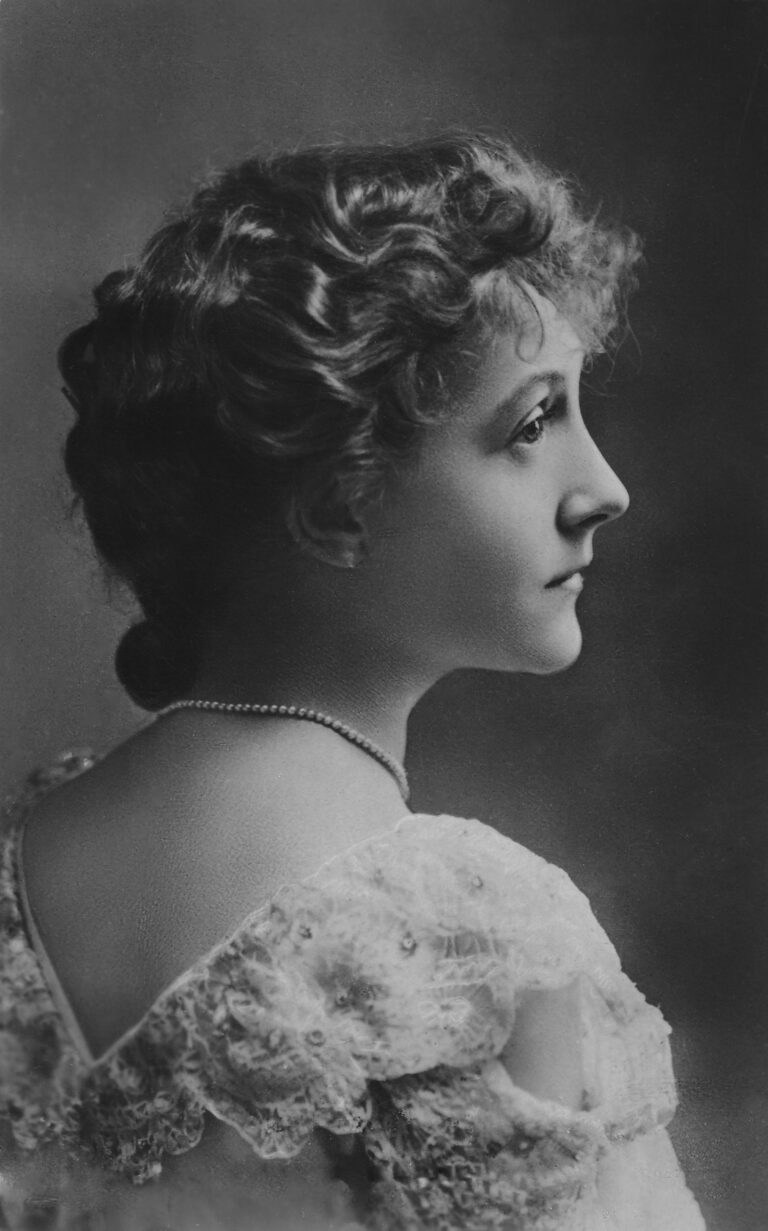
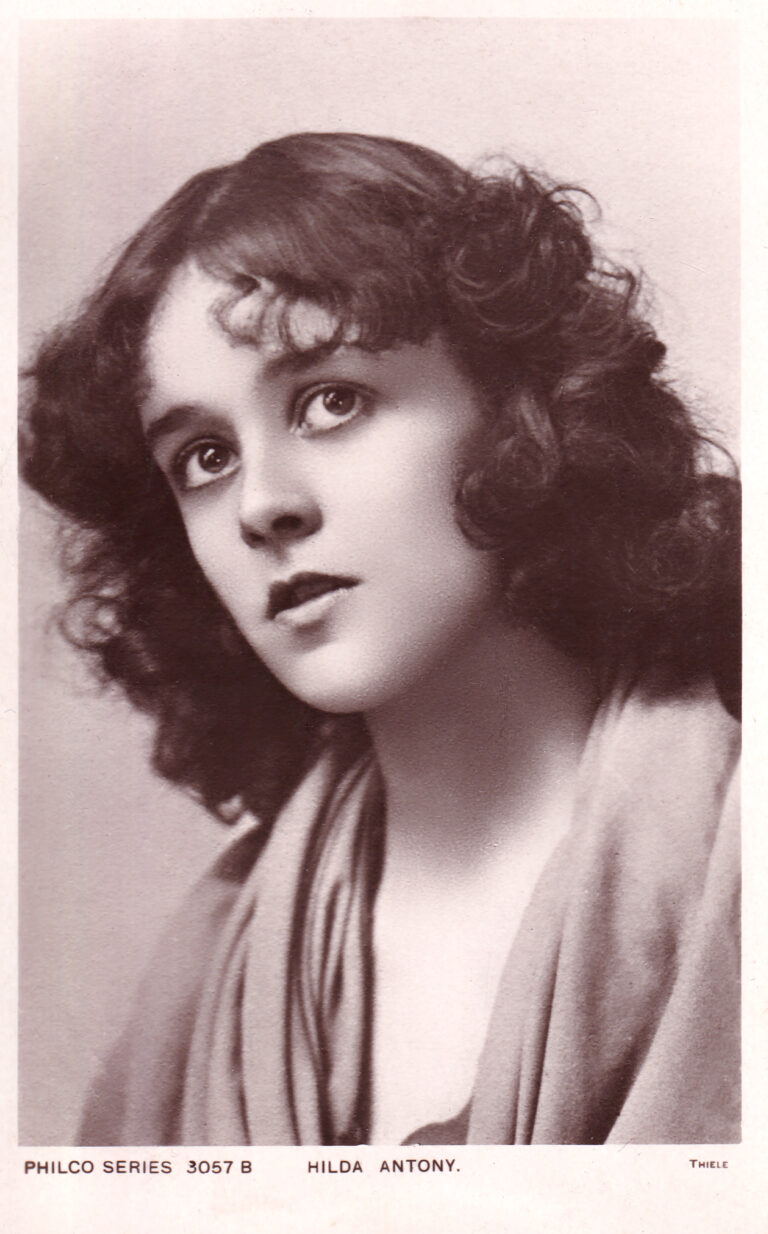
Two examples of Reinhold’s “high-class portraiture”, showing Grace Lane (1876-1956) and Hilda Antony (1886-1962). Portraits dating 1901-05. Reinhold Thiele Family Archive
The official list of all the services he provided by 1910 were:
- Workshop & Factory Interior photography
- Commercial photography in all its branches
- Catalogues Illustrated
- Wedding Groups & Banquet photography
- Legal documents in facsimile
- Advertising ideas carried out
- Permanent enlargements in oil, pastel, water-colour or monochrome
- Photographic developing and printing from amateur’s negatives
- Lantern slides
- Sporting photographs of every description
This list of services shows that Reinhold’s studio was far more than just the average photographic studio of its day, this was a full commercial enterprise that employed an entire team of people. In much the same way that his master Wunder had taken over a printing and lithographic business and turned it into a photography studio, Reinhold had done the same in reverse. Taking a small photography studio and almost expanding it into a small printing press.
Moscow & to the Skies
In his 2023 article, “Reinhold Thiele: Wunderkind and Pioneer” Matthew Butson, Vice-president of the Getty Images Hulton Archive places Reinhold in Moscow in 1903 in his quest to test and later patent a system to take panoramic photographs from balloons.
This wouldn’t be his first time experimenting with hot air balloons, having first experimented with them in the 1890s. But on this occasion, he would be travelling to Moscow to call upon the help or the daring French aeronaut, Captain Charles Gilbert.
Whilst Gilbert was a larger-than-life character, sadly very little is known of him, and his surviving papers have been split up and sold off. What is known is that his earliest recorded balloon ascent (Le Petit Parisien) took place in 1893, in which he flew from Versailles to the Montparnasse Cemetery in Paris. Several other flights in France are recorded, before he would move to Moscow in about 1900, where he would remain working for the Moscow Polytechnic University until the fall of the Russian Empire.
Importantly for Reinhold, Gilbert seems to have been a passionate photographer, and he owned a private hot air balloon with which he would take guests with him on expeditions. An example of this comes from Gilbert’s own papers, recording an attempt he made to take a party of guests from Moscow to the neighbouring Vladimir Oblast region; however, this was unsuccessful and they were taken significantly off course, landing in a remote forest of the Vologda Oblast region after 14hrs in the air. Gilbert records that it took nine and a half days to return, four of which were without food.
We don’t know how long Reinhold was there for and none of his panoramic photography is known to still exist, however, a couple of panoramic shots of Moscow still exist within Gilbert’s own papers, possibly from these very flights.
Another important part of this visit to Moscow was his visit to see the Russian write, Leo Tolstoy (1828-1910), who he would photograph as a part of this trip.
Tolstoy had stopped spending his winters in his Moscow residence from 1901, meaning that Reinhold almost certainly had to make the 120-mile pilgrimage from Moscow to the writer’s estate at Yasnaya Polyana.
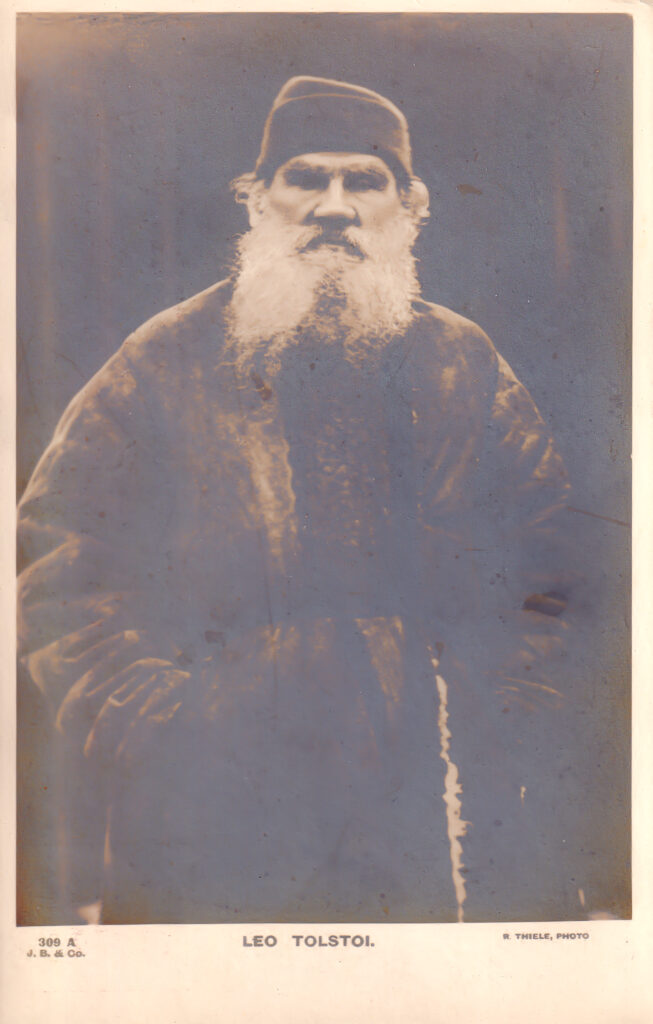
Reinhold’s 1903 portrait of Leo Tolstoy on a postcard. Several copies of this batch of postcards would be carried into Russia and autographed by Tolstoy in 1905. Reinhold Thiele Family Archive.
Reinhold’s photograph would become one of the defining late-photographs of Tolstoy, and several examples of postcards exist where they had been presented to the writer for him to autograph
Chemulpo Bay: The Russo-Japanese War
A discovery made in early-2026 would place Reinhold as an active observer of the outbreak of the Russo-Japanese war in 1904, something that was previously unknown.
The war broke out with the Empire of Japan’s surprise attack on the Russian Pacific Fleet on 9th February 1904. 18-days later a photograph would appear in The Graphic, a photograph by Reinhold of a Japanese cruiser going at full speed off Chemulpo, the modern-day city of Incheon.
The photo seems to have been taken from a distance, and although not formally identified, it seems to most likely be the Asama, an armoured cruiser and lead ship of her class that participated in the Battle of Chemulpo Bay.
How long Reinhold was there is unknown, but since this appears to be his sole photograph of the war, it seems he did not stay long and may in fact have stumbled into the beginning of the war by error.
We don’t know why or how he ended up in what was at the time, still the Empire of Korea and under the rule of its penultimate monarch, the Gwangmu Emperor, however, it may be speculated that Reinhold travelled across on the newly operational Trans-Siberian Railway. The line had just become operational as of 14th July 1903, and it would be reasonable to assume he may have travelled on from Moscow to experience what was then and still is today, the longest railway line in the world.
As the first decade of the 20th century moved on, Reinhold remained active, producing portraits of sporting celebrities, actresses, and dignitaries for the press whilst remaining active travelling to locations to photograph and interview people. An excellent example of this being his visit to the Tolstoy Colony at Tuckton House, Bournemouth, where he would meet and speak with Vladimir Chertkov (1854-1936), literary agent and friend of Leo Tolstoy. In an article published 9th February 1905 by the Bournemouth Graphic, and illustrated with photographs by Reinhold, it shows the Free Word Press that Chertkov was running, producing works and newspapers that were prohibited in his home county of Russia.
Reinhold would later travel out to Greytown, South Africa, attend the colonial trial of Dinuzulu KaCetshwayo, King of the Zulu, in March 1908. Dinuzulu had been put on trial in the aftermaths of the unsuccessful Bambatha Rebellion in 1906, which had resulted in the deaths of 3,000 to 4,000 Zulu. His photographic coverage was sent home to Britain to illustrate articles on the coverage of the trial.
Although not clear, two photographs from the Hulton Archive suggest that Reinhold may have, as a part of this journey, travelled further afield to Polynesia. Both photographs are listed as being of the “South Sea Islands”, showing dwellings and local inhabitants. It is not truly clear when Reinhold travelled out, but it seems it was unlikely to have occurred during his Boer War coverage or during his time in Korea, due to the outbreak of the Russo-Japanese War.
Reinhold reportedly remained active in encouraging the process of photography, as several articles from 1908 show he was a regular contributor to The Photographic Monthly, a journal that covered technical and artistic advancements in photography.
In 1909, Reinhold would travel to New York and stay there for eleven weeks. According to the Thiele family papers he was “working in connection with a process of colour-photography (Clifton)”. It is not clear what this work was or who he was working with as no other records of this visit are known to exist. If ‘Clifton’ was the name of the person he was travelling to see, then the two possibilities would either be the author and photographer Clifton Johnson (1865-1940), but who was not known to have taken colour photographs. Or Clifton Royal Adams (1890-1934), who is famous for his later colour autochrome process photographs for the National Geographic, however, he would have only been 19-years old at the time of Reinhold’s visit.